It started on a random Monday morning in my lab. Jackson had just gotten back from a weekend in South Dakota, and I'd just hatched a plan to go out there this summer to shoot some astro.
He wanted to come.
I told him he'd be bored. Astro shooting takes forever, and unless you're the one doing it, you're just standing in the dark watching someone fiddle with a Camera. Bored out of your mind.
But Jackson isn't the type to just stand around and do nothing. Climber, adventurer, pilot, and one of those rare friends you dream up high-impact photography ideas with, then obsess over for months until the picture in your head exists in the real world. We've done this before.
So we kept talking. And somewhere in that conversation, a plan started to form. A way for both of us to be doing the thing we love, at the same time, in the same frame.
I'd recently been studying this image. An award-winning shot of a climber on a glacier, under an eclipse. I couldn't stop thinking about it.
And there it was. The idea.
A climber, summiting a spire, under the stars.
He climbs. I shoot. Both of us doing what we love, in one picture.
There's a Japanese idea called misogi. Taking on something genuinely hard, on purpose. Something that tests you, right at the edge of what you can do.
This was going to be ours.
Because we didn't want to make it easy on ourselves. The challenge we set was to get everything right in camera. One frame, no compositing, minimal work in post. Which meant lighting a climber with multiple strobes, a thousand feet away, in the dark, and nailing it live. It meant a hard climb, at night. It meant wayfinding in the dark and scrambling to sketchy shooting perches for me.
None of us had done any of this before.
That was the point.
We spent the next few days obsessing over it. The perfect spire. The lighting. The shooting location. All the unglamorous stuff nobody sees, the scouting and the math that has to happen long before anyone presses a shutter.
There was one problem... I had never climbed before. I knew nothing about that side of it. So I started tagging along on climbs with Jackson and two friends of ours. Kidus and Nid. Kidus is Jackson's climbing buddy and belayer. They share the kind of trust only climbers and belayers do. He's also one of my favorite people to adventure with. Nid is a climber too. He has a long track record of entertaining our stupid ideas and coming along for the ride. The right crew for a project like this.
I had a lot to learn, and I picked up a lot. Made a few pictures of them along the way.


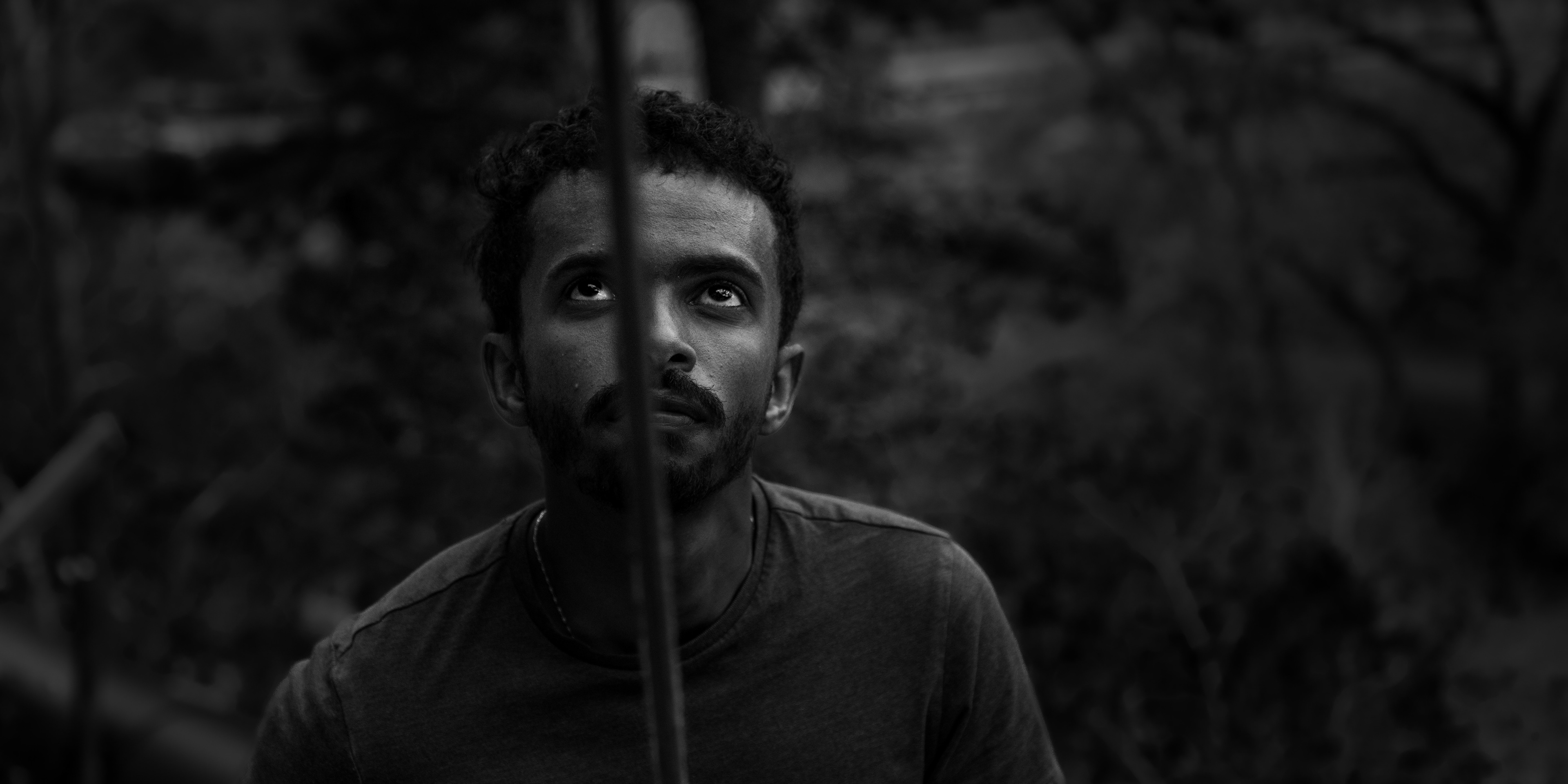
Then one night we decided to shoot after dark. We needed to figure out comms, because the shot we'd dreamt up had us roughly a thousand feet apart. You can't exactly yell across that.
So we kept it local. Boulder Canyon. Played around with a light wand, made a few interesting frames, put together some composites of the crew on a multipitch.
Getting to my shooting spot was its own adventure. A sketchy cliff, about 600 feet off the ground, with steep scrambling to reach it. Kidus got me up there, and hours later, got me back down in the dark, safely, both times. Turns out Jackson isn't the only one who trusts him with his life. Though my descent involved considerably less rope and considerably more cactus.
But we made it. Safely.
And I walked away with a long list. What needs to happen. What needs work. A bunch of technical camera stuff I'd only figure out by doing it wrong first.
Like I said. A lot to learn.
Fast forward a few weeks.
Jackson tells me about another rock. A good one for our idea, with the Milky Way lining up behind the climb, and Longs Peak sitting in the background.
The problem was time. We're all busy people, and that month was packed. I was off to Yellowstone for a week to photograph grizzlies. Jackson was in New York giving a talk.
We had exactly one day where we'd all be in town.
And it happened to fall on a new moon.
So we packed our bags and sent it that afternoon. We got to the spot, and it was a beautiful rock. A hard climb. Jackson sent it and reached the top.
And then the clouds came in.
It was an emotional roller coaster. Clouds rolling in, rolling out, teasing us all evening, until finally they just blanketed the whole sky.
Get used to the clouds. They become a recurring character in this story.
As the evening wore on, we made the hard call. We bailed. They weren't clearing, and we knew it.
But I walked away with something. Scale.
The Cathedral Spires up in South Dakota are massive. Each one is something like a thousand feet tall. Dramatic, yes. Beautiful, yes. But maybe too big for the picture we'd planned.
I got this quiet inkling that South Dakota might not be the shot at all. That this rock, right here, was probably going to work better.
I sat with that feeling. Didn't act on it yet.
A few weeks pass. Another new moon comes around the corner.
And we decide to push for South Dakota anyway.
It was unexplored territory for me. Great climbing for the crew. It was going to be a good time, regardless. We were still chasing the original dream shot.
The day we drove up, Jackson's van engine gave up.
No worries. We were taking two cars anyway. Nid became our expedition driver, and we crammed all the gear into his car, which by then genuinely looked like an expedition vehicle. Four people's worth of camping, climbing, and camera gear in a single car.
We got to South Dakota that evening, and the skies were unbelievably dark. Perfect conditions. We started getting excited for the days ahead.
The next morning was supposed to be clear.
It was not.
The weather shifted on us and went gloomy. Mist, drizzle, bad light, for a couple of days straight. But we caught the pattern. Stormy all day, clearing by evening.
We scouted the location that day. Insanely windy, 60mph gusts. Terrible for climbing, but the forecast had it dying down the next day. We found the spot I'd scouted on maps and on my computer screen, and finally saw it in real life. Checked our math. The Milky Way was, in fact, going to line up exactly where we'd planned.
The day of the new moon. Pouring rain in the morning.
But we stayed optimistic. The forecast said it'd clear by 11. It did not.
So we drove back to town, got lunch. New forecast. Clear by 2. We reached the spot at 2. More sad news. It had, in fact, not stopped raining. So we start heading back. And less than 200 yards down the road, no rain. This is it. The skies are clearing, or at least starting to. We park, grab our gear, and start the hike up to the climbing and shooting spots.
After a mile or so, we split. The two spots were different, about a mile apart. Jackson, Kidus, and Nid headed for the spire. I headed for my perch.
As I reach the shooting spot, the sky starts to open up. Exactly as we'd predicted.
But the wind hadn't fully died, and it was still cold.
The crew starts the grueling multipitch. They get almost to the top. On the last pitch, there's a stretch that's unprotected, no good spots for Jackson to place a piece for safety. With Kidus on the other end of the rope, he tries to find a line. Again. Again.
He gives it one last push. Makes it higher than any previous attempt.
And then disaster.
He slips and takes a ground fall. About 25 feet. A nasty one.
They call it on that climb and we regroup.
Our original plan had climbers on two different spires. So Jackson, still riding the adrenaline, comes up with a new idea. Everyone on this same spire instead.
But he was injured. And I could tell the adrenaline was doing the thinking.
I decided against it. We called it for the day.
I was also cold and miserable, if I'm honest.
Here's the thing about persistence. It matters more than almost anything in this kind of work. But just as important is knowing when to call it, before someone gets hurt, before someone's stuck in a downpour.
Photography and climbing both have this exact tension. You need the persistence to chase a dream shot. And you need the judgment to know when to walk away from it. It gets better over time. You learn to read the conditions. You learn how the weather behaves at a place.
So I didn't call this a missed shot.
I called it the first attempt.
And then we went back.
Not to South Dakota. To the rock that gave me that quiet inkling, the one with Longs Peak sitting in the background.
Turns out inklings are worth listening to.
This time, everything we'd learned came with us. And this time, it all had to land in a single exposure. No composites, no blending, no safety net in post. One frame, straight out of camera, with a climber lit against the Milky Way. The strobes had to be dialed in live, in the field, with no "fixing it later".
And for Jackson, a hard climb. At night. Because of course it couldn't just be a hard climb.
New moon. Clear skies. The Milky Way rising exactly where our math said it would.
No clouds. No wind. No falls.
Jackson on the rock. Strobes firing. Me on my perch in the dark, heart pounding, counting down the exposure. The shutter closes. The frame renders on the back of my camera.
And there it is.
This was it. This was the shot. Months of obsessing, sitting right there on that little screen.
We got it.

That was the misogi. The grade of the climb. Climbing it in the dark. The complexity of the lighting. Pulling it all off in camera, in one frame. Every single one of us pushed past something we hadn't done before.
Many attempts. A blown engine, a ground fall, and more clouds than I care to count.
But with enough persistence, you eventually get the shot you want.
And standing there in the dark, watching it come together on the back of my camera, I can tell you.
It was worth every attempt.